
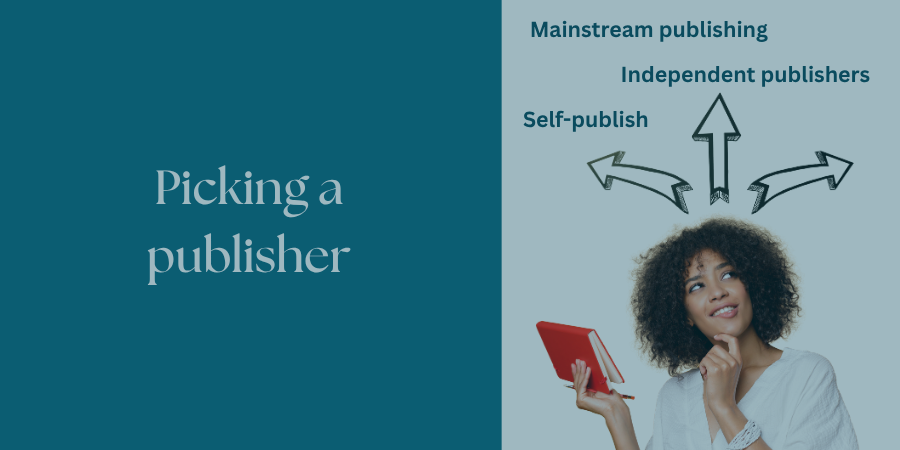
There are three main ways to get your book published – traditional publishing houses, independent publishers, and self-publishing. If you’re a first time author and you don’t have a connection in traditional publishing, my recommendation would be to find a good independent publisher and let them carry some of the load for you.
Why not self-publish?
In a nutshell – you don’t know what you don’t know! Self-publishing is not for the faint-hearted. You need to know what you’re doing and you need the time to do it. It’s not a way to save money – because you’re going to have to pay for every aspect that you don’t have expertise in – editing, proofreading (unless you have a friend who is pedantic about punctuation, spelling and grammar), an ISBN code, page layout for print, cover design, creation of epub documents for Kindle, Nook, Kobo etc., listing on Amazon, and a few other activities that most people don’t even know need to be done – like listing with wholesalers, Waterstones, etc.
Why not get a contract with a mainstream publishing house?
Because the majority of publishing houses don’t talk to authors! The days of submitting your manuscript for review (and rejection slips), or uploading your proposal are gone.
The only route to mainstream publishing is through a literary agent. So you still have to go through the submission, proposal pitch to interest an agent. If they like your work they’ll be the ones chasing the publishers and pitching your book. The downsides are that this can take months before a publisher shows interest, you’ll be sharing your royalties with your agent and mainstream publishers don’t pay much to start with.
So … independent publishers?
It’s a broad description and there are all kinds of options. You need to explore a range and find out what their package(s) offer. Not many include editing – or it’s an additional fee, but different independent publishers have different services included,
- Some include cover design – others don’t.
- Most include the book layout for print.
- They will all provide an ISBN – that comes with the description ‘publisher’, whoever buys the ISBN is the publisher (read the small print on Amazon if you decide to ‘self-publish’ through them – some of their options include the ISBN, meaning you are NOT self-publishing, but publishing through Amazon).
- Some independent publishers have in-house proofreaders, some don’t and some offer it at an additional fee.
- Some include a small number of copies included in the fee, others a proof, most will give you a special ‘author’s price’ to buy copies that you can use in your business marketing.
- Most will upload your digital ebook versions and list your book with all the main online booksellers, but check which ones they list with. You may want to list with other places.
- Most will do the listings with wholesalers, Waterstones, etc., but it’s wise to check.
- Some will do a little marketing, but find out about this. Some may even offer you a marketing service, do check out what that includes, content, frequency, etc.
The bonus is that you’ll get a much bigger chunk of the royalties. Usually at least three or four times what you’ll get from a traditional publisher.
If you market and promote your book well you may find a publisher approaches you (or sometimes a literary agent). Then it’s down to you to decide if publishing with them is worthwhile – and negotiate a bigger share of the royalties.
